
Product History and Statistics#
With history=True (the default), Keepa history is parsed into NumPy arrays
under product["data"]. Each available value array has a matching
*_time array.
History Availability#
Products do not necessarily contain every history type. Use get when
availability is not guaranteed. A key can be absent when Keepa has no history
for that product, when the product type does not support that history, or when
the request disables history parsing with history=False.
product = api.query("059035342X")[0]
history = product.get("data", {})
new_prices = history.get("NEW", [])
new_times = history.get("NEW_time", [])

for timestamp, price in list(zip(new_times, new_prices))[:10]:
    print(timestamp, price)
Common History Keys#
Key |
Meaning |
|---|---|
|
Amazon price |
|
Marketplace new or used price |
|
Sales rank |
|
List price |
|
Lowest new Fulfilled by Amazon price |
|
Lowest merchant-fulfilled new price with shipping |
|
Buy box price with shipping |
|
New offer count |
|
Rating history |
|
Review count history |
If NEW_FBA or NEW_FBM_SHIPPING is absent for a product, query with
history=True and treat the missing key as unavailable backend data rather
than a client parsing failure.
Plotting#
History values are discontinuous and are best represented as step plots.
import matplotlib.pyplot as plt

if "NEW" in history:
    plt.step(history["NEW_time"], history["NEW"], where="pre")
    plt.xlabel("Date")
    plt.ylabel("New price")
    plt.show()
The convenience plotter renders the available product histories directly:
keepa.plot_product(product)
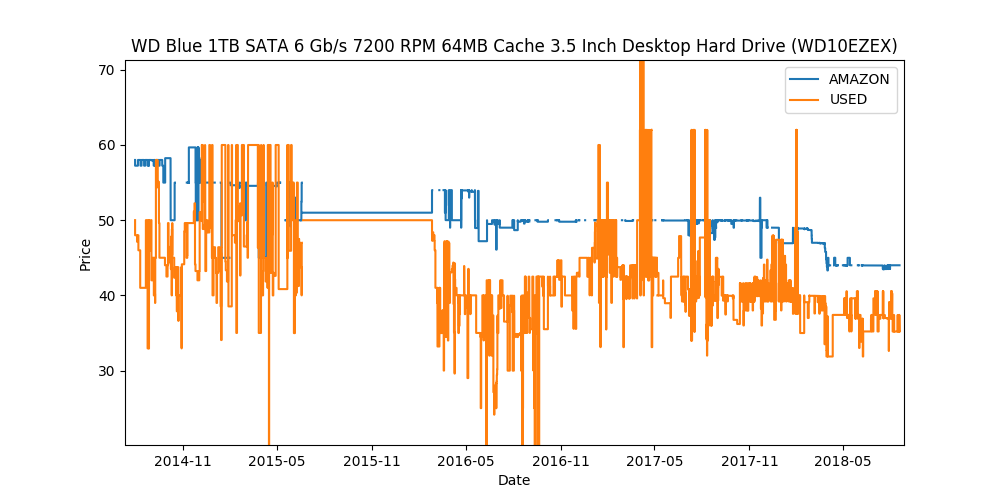
Amazon and marketplace price history#
Named Statistics#
Request statistics with stats. Raw positional arrays remain under
product["stats"] for compatibility; stats_parsed maps positions to
names such as AMAZON, NEW, and SALES.
product = api.query("059035342X", stats=90)[0]
stats = product.get("stats_parsed", {})

current_amazon_price = stats.get("current", {}).get("AMAZON")
minimum_new_price = stats.get("minInInterval", {}).get("NEW")
Minimum and maximum entries are (timestamp, value) tuples when present.
Keepa’s statistics object documentation defines the interval
semantics.
Typed Products#
Typed queries preserve the same parsed data and stats_parsed
convenience attributes when their source data is available. They are
client-generated extras rather than backend schema fields.